How does a new office and an extra $50,000 sound?

As a rookie recruiter back in my early years, I recall interviewing a guy for an interesting role in a high profile company that was undergoing expansion. Through all of our eyes (client, myself and the candidate) it offered growth, recognition and most importantly the culture he was looking for. He was excited, was offered $150k for the role which was fair for what it was, and accepted it. 2 weeks prior to starting he pulled out – the company he was working for and really hated, offered him an extra $50,000 and promised a new office locally, which he took.

What’s More Important – The Opportunity or The Starting Salary?

An extra $50,000 per year is nothing to sneeze at for most people – I don’t blame the guy for taking it – family came first for him and he had to do what’s right at the time. The problem was, when I followed him up not too long after, he was working away in a new company – he had left anyway. When I met up with him he had worked up a smile saying that he was happy in the new role and that the other guys hadn’t really come through for him – he got the extra money (7 months’ worth), the office had been delayed, but in the end, he was still working with the same people. On the other hand, the person we placed in our role was kicking goals and she really enjoyed the team and the interesting projects she was working on. One took the opportunity and the other took the money and left anyway.

What happens?

It’s the burning question that an employer would love to know about the candidate in front of them. Are they in front of me because it’s a great opportunity or are they just after the money? A large number of candidates just apply for a job which is fine  – as a recruiter we often hear things like “It was just an admin job. I’ve applied for heaps – which one’s this again?”

Some people desperately need the work, others apply for the role as it may improve their financial situation and some are just focused on escaping the madhouse that is their current job. Then there are others who look at the role on offer, see that it aligns with what they are looking for and actually research the company to see if it has the possibility of offering a career and learning new skills – they have a longer term, bigger picture strategy. I had a candidate that I placed as a CEO recently that took close to a $100k pay cut as the opportunity and huge expansion of their network was too good to refuse. When they finish their tenure, they will be well known in their region and have a heap of opportunity before them, just as their predecessor has right now.

What do you do?

As a candidate, it is a good idea to work out what’s important – work culture, career growth and the monetary rewards that go with it or just the chance to get more money? It’s a personal thing as we are all at different stages of our wants and needs. You also have to sell that story or vision when you are attending interviews and the best way to sell it is to be convinced yourself.

For yourself as an employer, you have to work out that what you are offering is attractive – is your company attractive, do you have a good work culture, do you pay fairly, do you offer further training or room to grow and also the ability for a person to earn more? How do you package that up to appeal to potential employees in the market? We all have to sell something compelling but it also has to be true so that people take the offer and stay with you. These are things that we focus on to help you attract the right person. When you need the help or would like to have a chat about how we do this, feel free to call us on 1300 558 979.


Yes, it’s 2017 and We Really Want to Help You Get That Job!

I got asked for my fax number the other day so that I could receive a resume – I just went blank for a moment. It was really interesting. Being a polite guy (and valuing that everyone is a customer) I asked if they were able to email it to me however, in the end, it was mailed to our PO Box and missed the cut off date. When you are in the job market and competing against others that are tech savvy, you need to come up to date in 2017 – really quickly or you may just miss out!

Some interesting observations (the not so great stuff):

Things that we have found from our experience this year alone include:

  • At least 5% of applications have no phone contact details on them
  • A further 5-10% at least have old or incorrect phone numbers
  • People are using old photos on their CV (I really wish I looked a lot younger too but i just don’t!)
  • Some photos look like they were taken by a 0.3 megapixel camera – C’mon, you aren’t really a Lego man!
  • When asked to submit a cover letter, close to a staggering 70% of people don’t do it
  • From the remaining 30% that submit a letter (thank you) barely half addressed the actual job ad
  •  Self awareness has dropped a bit – Be aware of how you present for interview not just your clothes but how you come across. Aggressive behaviours don’t generally make us feel like putting you forward to our client!

The good stuff (how you can do it better):

If you plan out your job hunting strategy, it will pan out for you in a positive way. The great news is that some job seekers are doing everything right, applying for the role or approaching us with the right tools and techniques, being interviewed, put forward to our clients and winning the role. We’ve placed a lot of great people into new careers this year and with a bit of work, we hope that you can be successful through our agency too! Here’s what you need to do:

  • Check and correct all the contact details on your resume (actually, make sure you have a resume first) – we want to call you!
  • Have a resume that is clean and easy to read. Some of the best candidates that we have placed had a very basic looking resume with the right information on it – it does not need to be flashy
  • If you choose to have a photo on your resume, don’t rush it. Dress up and get a professional head shot by someone else – not a selfie. Don’t crop a photo from a nightclub – it makes it look like you cropped a photo from a nightclub
  • Do a cover letter regardless of what anyone says – a really easy formula is to address it, attention it to the right person, state the role you are applying for, then state in bullet point form your skills in relation to the actual job ad. It can be more formal and include further information however, just doing this alone puts you above 70% of other applicants – it shows you actually read the ad
  • Have a good and honest friend give you feedback about how you present – are you naturally aggressive, too passive, talk over others, don’t listen or come across as an ‘expert’ (even though you are not). If done properly, you may find an area for self-development that can not only get you selected, but change your career prospects forever. A bit of self-awareness is an awesome thing sometimes

When we see your application come through and you stand out, we speak on the phone and you sound welcoming and easy to talk to, chances are we will be asking you to come in for interview. We want you to be that person. Remember, it’s 2017, your competition is up to date, aware of what is happening in the marketplace and are acting competitively. You need to be doing this too!

We hope this helps and if you need assistance (or know someone that does), please call or pass our details on. Our office is open weekdays and you can call us on 1300 558 979.


It’s Only Money – Right?

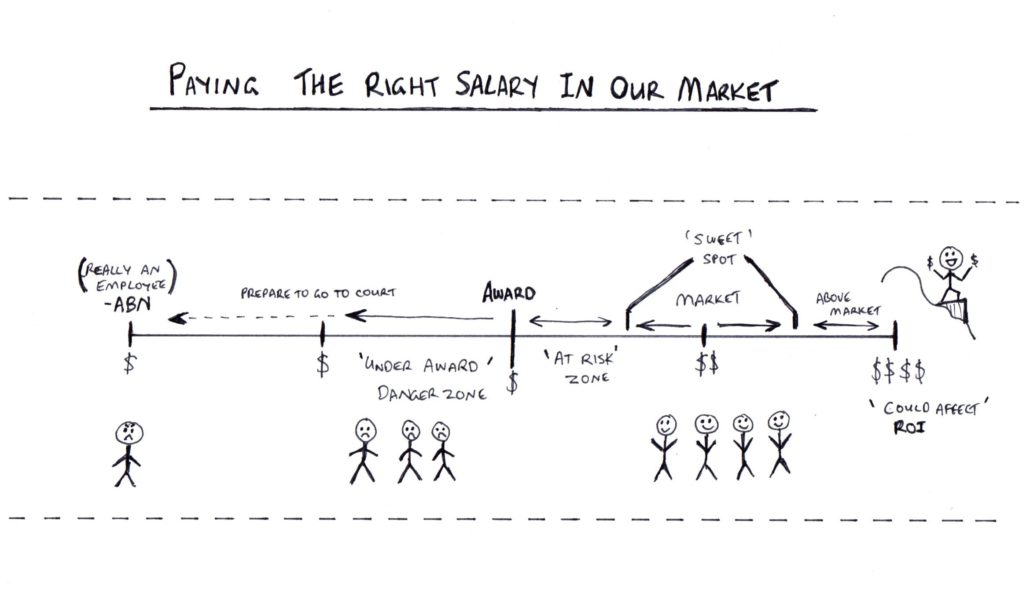
If you’re an employer that pays the Award rate or on the other hand, pays well below market rates, you could be at risk of your staff regularly keeping an eye out for a better paying role. Sometimes people just accept a job because they need one and just because you’ve filled the role, they may still be looking for the ‘better’ opportunity.

What is the right rate of pay for a role? It really is an open ended question. Some employers wish to pay the Award and that’s actually ok – it’s correct. Some wish to pay a lower salary than the market and make up for it with overtime and bonuses as a lure – this also works on occasion. Some pay well above the market rate which is attractive but can eat into the ROI and then there is the group that pay all within a certain market rate. Neither of these options are incorrect, however, what actually attracts a person to accept your role? There are quite a few answers to that question besides money, however, from our experience in the market, it sits very, very high on the list of things that applicants consider.


How do you know what salary to offer / accept?

Now you have to be reasonable here and not go off false information (there’s plenty of that out there). You need collective data. From an employer’s side, you would be silly to take a stab at what you feel is fair to pay someone for a role and hope that someone will take it. Likewise from an employee’s side you can’t just go off the information from a friend who is in a similar role to you but gets paid a whole lot more – one person is not the market. Likewise, if you have just finished Uni and the lecturer suggested that you should be worth $60k because you have a Degree now, it’s also probably (definitely) not correct.

You can look up the Award rate and pay that and you can also look at salary surveys that have been released however, realistically for our market on the Gold Coast, use them as a loose guide and not fact. You can pull a figure out of the air that you feel represents what you would pay for the role (we actually see this often) and could be correct or completely miss the mark. I had a client quite a while ago where every the answer to ‘what do you want to pay’ (for any role) was $45k – that was out by as much as $35k on the worst occasion. Some employers also look at the ABN option as it’s easier/cheaper, except when the person suddenly feels ‘wronged’ a year down the track and you end up with a FWO claim from your now identified ’employee’ not contractor.

The best options:

Yes, you have options and neither of the 3 below methods takes very long at all. They could also save you time and effort and work for you in a positive way to attract the best candidates in the market.

  • Make a call – Call a Recruiter or HR Consultant and ask what they have found when recruiting similar roles. Without spelling it out too much, Recruiters work with the market on a daily basis and can give you the salary range and benefits of recent roles they have filled – this is good information to decide on what you will pay for what particular skill level you are after.
  • Visit an online Job Board – Jump onto a job board such as SEEK type in the role you are reviewing or wishing to recruit as well as the region and look at the results. The majority of salaries are missing from the results however, every role that is posted has to have a salary range behind the scenes. From the results, use the ‘salary slider’ to work out where the majority of roles fall  – this could be a good guide to work from.
  •  Get job applicant feedback – Applicants are the market. Use the question ‘What salary range are you seeking for this role’ during your phone screening before selecting an applicant for interview and there’s your feedback. When reviewing your phone screening/shortlisting form have a look at the responses from those that you are keen on and that could be an indication of the market. Don’t discount the higher end ones either – they may ‘want’ a particular salary however we have often found that ‘want’ and ‘currently on’ are sometimes quite different.

Just doing one or all of the three points above should clear up a few questions you may have. If you do have questions regarding what to pay someone on an upcoming recruit or are conducting salary reviews soon, feel free to call our office on 1300 558 979. We are happy to help you.