Industry Specific Influencers are your new Marketing Tactic

It’s unquestionable that influencer marketing has had a powerful impact on relationship driven advertisement. We’ve watched as start-up businesses skyrocket into billion dollar enterprises through the use of influencer and celebrity endorsement. Having brand collaborations on social media from the likes of Kim Kardashian and Conor McGregor once embodied what successful influencer marketing looked like. However, more recently, consumers are looking to build genuine connections and while celebrity advertisement has an extensive reach, it lacks authenticity. The modern influencer takes action, not just selfies, they create their own brand image and voice that allows them to build authentic relationships with followers in their network. These influencers have created strong social media profiles within industries, finding their niche and demonstrating an expertise.

We’ve been watching this happen locally in the real estate, legal, marketing and advertising realm. In an effort to find out some more information, we reached out to some of these industry professionals to find out how building a social media presence has impacted their career and what gave them the initial push to create authentic contact. These professionals are likeable because they have a clear purpose, connecting on a more meaningful level with consumers by having a reason why. They’ve become a go-to person within an industry or area of expertise, stretching far beyond the target of just making sales. This has become a likeable and well recognised attribute noticed by employers. Influencers within industries are generating and developing business without the traditional outbound sales focus, instead, creating content and engagement on a personal level, raising the awareness of those around them to generate leads and referrals. Employers are no longer just looking for a candidate that meets a checklist of qualifications, they want creative and confident individuals who have marketed themselves well within the industry and have an established network of contacts to bring with them.

A strong social media presence is allowing industry professionals to build rapport and create valuable content for their audience before they have even met. These influencers are creating an identifiable presence across a range of social media platforms, giving current and prospective clients an insight into their personality traits, interests and values. This fresh approach of influencer marketing has been manifested by professionals on LinkedIn, Instagram, Facebook and Twitter. For industry professionals that are ahead of the game, they’re saturating the market across multiple platforms, leading to high engagement and a well-connected network.

What we found:

The biggest piece of advice I have acquired from speaking with and observing these influencers is that content is not just about you as an individual, it’s about the value-add of your network. Networking is about the relationships you create with like-minded individuals and social media provides industry professionals with a platform that allows them to share these experiences with others and take people along for the journey. In our current content driven digital age there is no doubt that industry professionals who are thriving within their niche are extremely attractive to employers, however, job opportunities and offers are not the end goal. What makes the modern professional influencer so unique and appealing is the transparent relationship they share with their employer. Not only do they create a strong personal brand image but they also become a spokesperson and representative for the company. To them, the term influencer is no longer associated with a selfie driven livelihood; it has become a way for those individuals to deliver valuable industry specific content and nurture relationships within their community. The content they deliver serves a purpose and communicates on a deeper level. it’s authentic and unedited, adding value to the audience.

When creating a business marketing strategy, we identify the company’s unique selling proposition (USP) to better understand what differentiates our service from competitors, more simply, why should prospective clients choose us?  Influencers within industries have developed a personal brand for themselves over time by maintaining reputation, image and relationships. Industry professionals who have successfully done this have identified their personal unique selling proposition. They have advertised themselves as a brand within their professional industry. From our research, we found that to market yourself well within an industry you must first and foremost know yourself. You must then identify with what makes you different, be genuine and tell your audience a story that is authentic to your personal brand. Don’t feel frightened or intimidated by a competitive marketplace, instead, take it as an opportunity to become the industry influencer who delivers meaningful, engaging and valuable content to your audience. I agree with Gary Vaynerchuk who has said that “not paying attention to your competitors will become your power.” Industry professional influencers possess the empowering mindset of focusing on their personal goals and growth, advising others to do the same.

The rapid growth of digital marketing has created a space for niche industry-specific influencers, proving to be a powerful tool for professionals. In the tech savvy age of filters and facetune, authentic content has never mattered more.

We would like to thank Lana Woltman, Tegan Boorman, Chris Hogan and Willow Sloane for taking the time to contribute to our research.

Mental Health Awareness Month: Wellbeing at Work

How a wellbeing strategy can benefit your workplace.

Following on from our previous article surrounding the topic of mental health, we have outlined the key areas necessary for implementing a sustainable wellbeing strategy in your workplace. Managing the wellbeing of staff includes monitoring workplace culture, staff remuneration and a healthy work-life balance.

Wellbeing strategy

In the past, people have only associated wellbeing as a physical concept. Employers have covered the costs for staff training, gym memberships, nutritious snacks and even yoga classes for employees. However, more recently, wellbeing in the workplace stems far beyond just a physical notion. It’s an overall understanding of an individual’s mental, physical and emotional wellbeing. Implementing a wellbeing strategy will benefit your workplace and enable you to better understand the needs of your employees. Several factors contribute to the wellbeing of staff, such as culture, support and career progression. Ensure you’re proactive in the day to day productivity of your team and get to know them on a personal level. This will help you pick up on any behavioural changes from your staff, such as disinterest, disengagement or mood swings. Talk to your employees privately as well as in a team environment, make mental health an open topic for discussion. Investing in a wellbeing strategy will boost employee productivity and retention for your business. Every workplace culture is unique so it’s advantageous that you take a tailored approach that will be beneficial and appeal to your employees.

Improve team communication – You want your staff to feel as though they are part of a team. Isolation can be a huge contributor to mental health, group activities and tasks are a great way to improve team communication.

Identify the needs – When you can identify the needs of your employees you can better understand what changes and strategies need to be made. You can get valuable information from employees through staff meetings, performance reviews and general feedback.

Flexible work hours – If an employee is noticeably struggling to get to and from work, offer flexible hours or a work from home alternative.

Guest speakers on mental health – Having a seminar during work hours about mental health will generate conversation.

Mental health day – Staff shouldn’t feel hesitant about taking a mental health day. The goal is not to get out of work; it’s to heal your mind so you can return back to work more energised and relaxed. Be transparent with your team by letting them know that you support this notion.

Talk about mental health

Mental health should be a topic open for discussion in all aspects of life, especially in the workplace. The stigma associated around mental health can make employees feel afraid to talk to their boss and co-workers. They often feel afraid of losing their job and damaging relationships. By encouraging employees to be transparent about their personal issues facing mental health you will create a culture of acceptance. An employee who feels as though they can be open and honest is more likely to perform at work over an employee who feels stressed and isolated.

Prioritising mental health and wellbeing at the heart of your workplace will create a culture that is transparent and accepting. There are several values you can communicate and demonstrate to employees that will generate cultural awareness. By expressing inclusivity, encouragement and trustworthiness in the workplace it’s more likely employees will view it as a safe place. Showing emotion is not a weakness, be transparent about letting your team know that you care and can offer support. Create a culture where staff can feel comfortable about sharing their struggles facing mental health with fellow co-workers.

As employers and employees, we can do better to remove the negative stigma associated with mental health in the workplace. Strive towards creating a workplace that is accommodating and willing to help. It’s time we learnt how to talk about mental health.

Thanks for reading,

Sophie and David.

Mental Health Awareness Month: Dealing With Rejection / Criticism

October is Mental Health Awareness month, giving Australians the chance to take a step back and reflect on how they can support the people around them. We wanted to contribute by writing an article that generates conversation about mental health with a recruitment perspective.

Being rejected for a job hurts. Just like receiving negative feedback hurts. It’s only human for your emotive mechanics to come into play in these unavoidable situations. With every job application and interview follows the fear of rejection. As an employer, It’s actually quite likely according to statistics, that you will have an employee who suffers from a mental illness at some point in your career, whether it’s known to you or not. Navigating the topic of mental health can be difficult and uncomfortable for some, however, a study conducted by Beyond Blue found that 91% of Australian employees believe mental health in the workplace is important. There are strategies and tactics both the employer and employee can take to ensure the workplace is a mentally healthy environment.

Delivering and receiving constructive criticism

There is no doubt that a negative stigma surrounds the topic of criticism. It’s never going to sit well when someone critiques the work you put so much of your time and effort into, however, there is a reason it’s often rephrased in the workplace as ‘constructive’ feedback.  As an employee, having a positive outlook will determine how you respond and react to difficult conversations. Rather than viewing constructive criticism as a negative, see it as an opportunity for personal growth and development. Instead of asking yourself, what did I do wrong? Ask yourself, what can I learn from this? Or, what’s the next step?

As an employer, the approach you take to deliver criticism will determine how your employee will feel about the situation. Constructive criticism is a fundamental and inevitable stepping stone for employee growth. Take a subtle approach to the conversation and talk through what needs to be improved. Give your employee an explanation, why does it need to be improved? What isn’t working? The biggest mistake a lot of employers make is finishing the conversation with the negative. Before finishing the conversation, also highlight the positive components of their work. For example you could say, “Although that didn’t work, I liked how you approached this task.” If an employee feels supported and appreciated, they will be more likely to deliver results.

Dealing with rejection

From a young age, we’re told not to take anything personally. The truth is, rejection is never going to feel good, even if you saw it coming. When you apply for a job you invest yourself into that relationship, you want it to work out and you’ve put your time and energy into writing what you hoped was the perfect cover letter. It’s going to be disappointing when that relationship doesn’t work out, but there are ways you can better handle the situation. You don’t want to be left with questions unanswered. Ask the employer or recruiter why you weren’t successful in the position, and ask what improvements you could make to your application before applying for future jobs. This will give you peace of mind and avoid any assumptions.

At New Point Recruitment, we understand that rejecting candidates is a necessary component of the hiring process. Our director, David Ford, says he has always remembered the quote “Tact is the knack of making a point without making an enemy.” Tact personifies the importance of interpersonal skills and smooths difficult conversations. While a candidate might be unsuccessful in a job position, it doesn’t’ mean they couldn’t be the ideal fit for another role. We value the relationships we have with all our candidates and if unsuccessful they will remain in our network and can choose to be updated with future job opportunities.

In part 2 of our article, we will be focusing on wellbeing and discussing mental health within the workplace… stay tuned…

Thanks for reading,

Sophie and David

Attracting Professionals to Your Firm

(3 minute read): Hiring professionals for your firm can be an overwhelming and challenging process. With the right tactics and an understanding of what attracts a person to your business, a recruiter can work with you to navigate this process and source appropriately qualified and talented professionals for you.

As an employer, there are ways you can market your business to make it more appealing to professionals. Some strategies that will ensure you attract candidates with the right talent include:

Reputation – Become known as a great employer

Building a strong brand perception will strengthen the reputation of your company. A good reputation will add value to your business and make it more likely to attract candidates who share similar values. Reputation is developed over time in a number of different ways. Prioritise the happiness of your team by keeping them positive and motivated. You want current and former employees to talk positively about the workplace, making potential candidates feel as though it’s a culture they would like to contribute to.  As an employer, it’s vital that the relationship you share with your clients reflects positively on the principles and ethics of your business and should be shared with your team and on your website through client testimonials. Your clients are a fundamental contributor to your success and reputation and giving people access to what your clients say about you, will give a long term benefit.

Present yourself as a professional business

As simple as it may sound, if you want to attract the right talent for your company, you must present yourself as a professional business. You want to be easily accessible and present a professional image to future candidates. Branding should be consistent and communicate the values and service you provide. You will struggle to attract professional candidates if your business isn’t marketed to appeal to these individuals.

Identify your benefits and use them

If you want to attract professional candidates, you need to be able to identify what you can offer them and use this to your advantage. Differentiating yourself by highlighting the benefits you can offer to an ideal candidate will show the calibre of employee you are hoping to source. For example, being able to offer a generous remuneration package, ongoing professional development, a good culture and ample office space will be attractive to a potential employee. Know your strengths as a business and know what differentiates you from your competitors. When recruiting professional roles it’s likely you will have applicants who are coming from these competing firms.

Education and experience – Finding a balance  

As you’re aware, when employing industry professionals there are required qualifications applicants must obtain to be considered for the position. Having a solid job specification outlining these requirements as well as the ideal person specification will help you define what you are really requiring to help grow your business. It’s essential that you conduct background and reference checks to verify information that you receive from a candidate. In our process at New Point, we like to cross reference the candidate, not just by contacting references but also looking into the candidate’s social media channels and verifying qualifications. An industry professional should have an up to date LinkedIn profile and a well-connected network. Social channels such as LinkedIn are creating Influencers within specific industries – we’ve seen it and these people are creating well-connected networks that could be advantageous to your firm.

If you’re unsure of how to market yourself to attract prospective talent, the team at New Point will happily assist you in creating a strong profile to advertise and market your vacancy. We can also direct you to experts who can help you increase your brand awareness in the market.

Thanks for reading,

Sophie and David.

How to Retain my Generation – Millennials

This week, we have a contribution from our new Marketing Assistant Sophie with her views on how to retain her generation – millennials:

The stereotype of millennials jumping from one job to the next is all too real. I would know, because I am one. I’ve even come across articles that refer to us as the job-hopping generation. A fast staff turnover can reflect negatively on the employer, ultimately devaluing the culture of a workplace. So, how can employers retain the younger generation? And more importantly, can they?

Although it’s still common for employees to stay within a company for job security, millennials are becoming more subjective to the opportunity of learning new skills and growing their resume. We have grown up in a tech savvy generation that allows us to constantly remain connected and encourages us to explore our talents. The reality is, by 2025, millennials will make up majority of the workplace.

We’re not scared to leave a job that is no longer meeting our financial or emotional needs. Society has shifted and employers need to adjust to these changes if they want longevity from their staff.

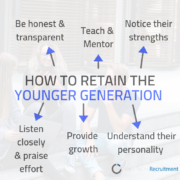
Some thoughts on how to retain millennial employees:

Understand them – If you want to hire and retain the younger generation, you have to understand them. It’s no longer just money they want from a job, its value and flexibility. They want to maintain a healthy work life balance. This might involve modifying the job position to attract a younger candidate. For example, in an earlier article we suggested offering the opportunity to work from home (5 Ideas to Attract the Best Talent For Your Business). Offering job flexibility will guarantee you attract the best talent for your business.

Career progression and recognition – Deloitte has released The 2019 Global Millennial Survey, which found that the younger generation are disillusioned. They struggle to feel fully satisfied with their lives, their job position, financial situation, and social media status. These findings can help employers navigate their relationships with younger generation staff. Showing recognition for good work will help satisfy your staff member. We have become accustomed to sharing every aspect of our life on social media, receiving instant gratification in the form of likes and interactions. Employers can adapt to this approach by giving their staff gratification in the form of rewards and recognition.

Positive workplace culture – A positive workplace culture has proven to improve staff productivity and longevity. A brand that embodies a positive culture will attract staff with like-minded values. If an employee feels valued as part of a team, they will be more likely to want to grow within that company. Millennials will want to contribute to a team that prioritises physical and mental well-being. Building positive relationships with staff is what cultivates culture, take the time to connect with your team and be transparent about how you feel.

Opportunities and diversity – Keeping your workplace diverse will generate innovation from your staff. Always be open to suggestions. As an employer it’s important to allow room for your staff to establish and prove themselves. Give the younger generation opportunities that will challenge their skillset and keep them engaged within their position.

Thanks for reading,

Sophie.