How does a new office and an extra $50,000 sound?

As a rookie recruiter back in my early years, I recall interviewing a guy for an interesting role in a high profile company that was undergoing expansion. Through all of our eyes (client, myself and the candidate) it offered growth, recognition and most importantly the culture he was looking for. He was excited, was offered $150k for the role which was fair for what it was, and accepted it. 2 weeks prior to starting he pulled out – the company he was working for and really hated, offered him an extra $50,000 and promised a new office locally, which he took.

What’s More Important – The Opportunity or The Starting Salary?

An extra $50,000 per year is nothing to sneeze at for most people – I don’t blame the guy for taking it – family came first for him and he had to do what’s right at the time. The problem was, when I followed him up not too long after, he was working away in a new company – he had left anyway. When I met up with him he had worked up a smile saying that he was happy in the new role and that the other guys hadn’t really come through for him – he got the extra money (7 months’ worth), the office had been delayed, but in the end, he was still working with the same people. On the other hand, the person we placed in our role was kicking goals and she really enjoyed the team and the interesting projects she was working on. One took the opportunity and the other took the money and left anyway.

What happens?

It’s the burning question that an employer would love to know about the candidate in front of them. Are they in front of me because it’s a great opportunity or are they just after the money? A large number of candidates just apply for a job which is fine  – as a recruiter we often hear things like “It was just an admin job. I’ve applied for heaps – which one’s this again?”

Some people desperately need the work, others apply for the role as it may improve their financial situation and some are just focused on escaping the madhouse that is their current job. Then there are others who look at the role on offer, see that it aligns with what they are looking for and actually research the company to see if it has the possibility of offering a career and learning new skills – they have a longer term, bigger picture strategy. I had a candidate that I placed as a CEO recently that took close to a $100k pay cut as the opportunity and huge expansion of their network was too good to refuse. When they finish their tenure, they will be well known in their region and have a heap of opportunity before them, just as their predecessor has right now.

What do you do?

As a candidate, it is a good idea to work out what’s important – work culture, career growth and the monetary rewards that go with it or just the chance to get more money? It’s a personal thing as we are all at different stages of our wants and needs. You also have to sell that story or vision when you are attending interviews and the best way to sell it is to be convinced yourself.

For yourself as an employer, you have to work out that what you are offering is attractive – is your company attractive, do you have a good work culture, do you pay fairly, do you offer further training or room to grow and also the ability for a person to earn more? How do you package that up to appeal to potential employees in the market? We all have to sell something compelling but it also has to be true so that people take the offer and stay with you. These are things that we focus on to help you attract the right person. When you need the help or would like to have a chat about how we do this, feel free to call us on 1300 558 979.


Yes, it’s 2017 and We Really Want to Help You Get That Job!

I got asked for my fax number the other day so that I could receive a resume – I just went blank for a moment. It was really interesting. Being a polite guy (and valuing that everyone is a customer) I asked if they were able to email it to me however, in the end, it was mailed to our PO Box and missed the cut off date. When you are in the job market and competing against others that are tech savvy, you need to come up to date in 2017 – really quickly or you may just miss out!

Some interesting observations (the not so great stuff):

Things that we have found from our experience this year alone include:

  • At least 5% of applications have no phone contact details on them
  • A further 5-10% at least have old or incorrect phone numbers
  • People are using old photos on their CV (I really wish I looked a lot younger too but i just don’t!)
  • Some photos look like they were taken by a 0.3 megapixel camera – C’mon, you aren’t really a Lego man!
  • When asked to submit a cover letter, close to a staggering 70% of people don’t do it
  • From the remaining 30% that submit a letter (thank you) barely half addressed the actual job ad
  •  Self awareness has dropped a bit – Be aware of how you present for interview not just your clothes but how you come across. Aggressive behaviours don’t generally make us feel like putting you forward to our client!

The good stuff (how you can do it better):

If you plan out your job hunting strategy, it will pan out for you in a positive way. The great news is that some job seekers are doing everything right, applying for the role or approaching us with the right tools and techniques, being interviewed, put forward to our clients and winning the role. We’ve placed a lot of great people into new careers this year and with a bit of work, we hope that you can be successful through our agency too! Here’s what you need to do:

  • Check and correct all the contact details on your resume (actually, make sure you have a resume first) – we want to call you!
  • Have a resume that is clean and easy to read. Some of the best candidates that we have placed had a very basic looking resume with the right information on it – it does not need to be flashy
  • If you choose to have a photo on your resume, don’t rush it. Dress up and get a professional head shot by someone else – not a selfie. Don’t crop a photo from a nightclub – it makes it look like you cropped a photo from a nightclub
  • Do a cover letter regardless of what anyone says – a really easy formula is to address it, attention it to the right person, state the role you are applying for, then state in bullet point form your skills in relation to the actual job ad. It can be more formal and include further information however, just doing this alone puts you above 70% of other applicants – it shows you actually read the ad
  • Have a good and honest friend give you feedback about how you present – are you naturally aggressive, too passive, talk over others, don’t listen or come across as an ‘expert’ (even though you are not). If done properly, you may find an area for self-development that can not only get you selected, but change your career prospects forever. A bit of self-awareness is an awesome thing sometimes

When we see your application come through and you stand out, we speak on the phone and you sound welcoming and easy to talk to, chances are we will be asking you to come in for interview. We want you to be that person. Remember, it’s 2017, your competition is up to date, aware of what is happening in the marketplace and are acting competitively. You need to be doing this too!

We hope this helps and if you need assistance (or know someone that does), please call or pass our details on. Our office is open weekdays and you can call us on 1300 558 979.


It’s Only Money – Right?

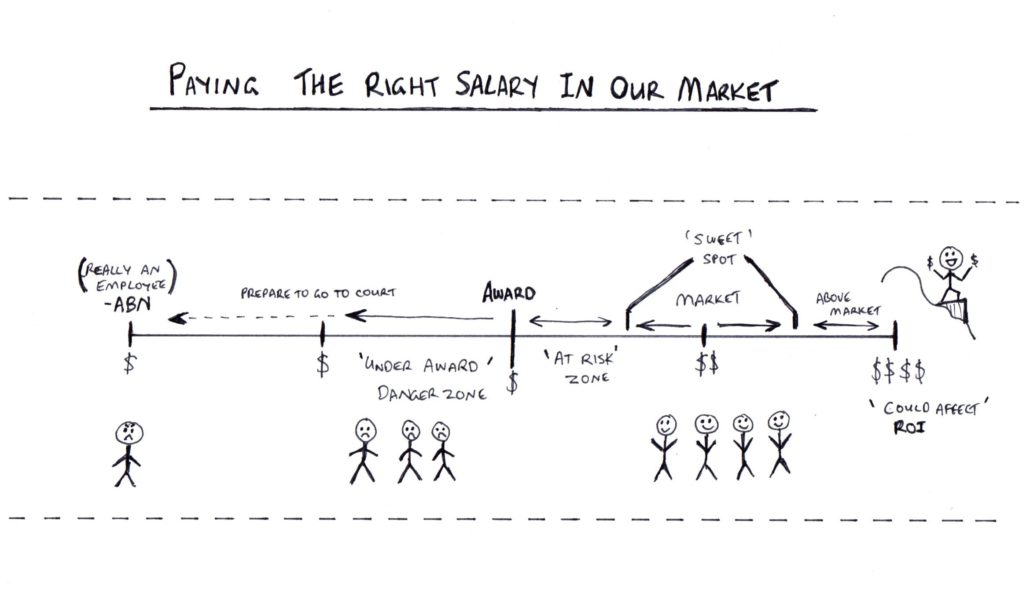
If you’re an employer that pays the Award rate or on the other hand, pays well below market rates, you could be at risk of your staff regularly keeping an eye out for a better paying role. Sometimes people just accept a job because they need one and just because you’ve filled the role, they may still be looking for the ‘better’ opportunity.

What is the right rate of pay for a role? It really is an open ended question. Some employers wish to pay the Award and that’s actually ok – it’s correct. Some wish to pay a lower salary than the market and make up for it with overtime and bonuses as a lure – this also works on occasion. Some pay well above the market rate which is attractive but can eat into the ROI and then there is the group that pay all within a certain market rate. Neither of these options are incorrect, however, what actually attracts a person to accept your role? There are quite a few answers to that question besides money, however, from our experience in the market, it sits very, very high on the list of things that applicants consider.


How do you know what salary to offer / accept?

Now you have to be reasonable here and not go off false information (there’s plenty of that out there). You need collective data. From an employer’s side, you would be silly to take a stab at what you feel is fair to pay someone for a role and hope that someone will take it. Likewise from an employee’s side you can’t just go off the information from a friend who is in a similar role to you but gets paid a whole lot more – one person is not the market. Likewise, if you have just finished Uni and the lecturer suggested that you should be worth $60k because you have a Degree now, it’s also probably (definitely) not correct.

You can look up the Award rate and pay that and you can also look at salary surveys that have been released however, realistically for our market on the Gold Coast, use them as a loose guide and not fact. You can pull a figure out of the air that you feel represents what you would pay for the role (we actually see this often) and could be correct or completely miss the mark. I had a client quite a while ago where every the answer to ‘what do you want to pay’ (for any role) was $45k – that was out by as much as $35k on the worst occasion. Some employers also look at the ABN option as it’s easier/cheaper, except when the person suddenly feels ‘wronged’ a year down the track and you end up with a FWO claim from your now identified ’employee’ not contractor.

The best options:

Yes, you have options and neither of the 3 below methods takes very long at all. They could also save you time and effort and work for you in a positive way to attract the best candidates in the market.

  • Make a call – Call a Recruiter or HR Consultant and ask what they have found when recruiting similar roles. Without spelling it out too much, Recruiters work with the market on a daily basis and can give you the salary range and benefits of recent roles they have filled – this is good information to decide on what you will pay for what particular skill level you are after.
  • Visit an online Job Board – Jump onto a job board such as SEEK type in the role you are reviewing or wishing to recruit as well as the region and look at the results. The majority of salaries are missing from the results however, every role that is posted has to have a salary range behind the scenes. From the results, use the ‘salary slider’ to work out where the majority of roles fall  – this could be a good guide to work from.
  •  Get job applicant feedback – Applicants are the market. Use the question ‘What salary range are you seeking for this role’ during your phone screening before selecting an applicant for interview and there’s your feedback. When reviewing your phone screening/shortlisting form have a look at the responses from those that you are keen on and that could be an indication of the market. Don’t discount the higher end ones either – they may ‘want’ a particular salary however we have often found that ‘want’ and ‘currently on’ are sometimes quite different.

Just doing one or all of the three points above should clear up a few questions you may have. If you do have questions regarding what to pay someone on an upcoming recruit or are conducting salary reviews soon, feel free to call our office on 1300 558 979. We are happy to help you.

The Steps I Took as a Graduate to Secure a New Job

This week we have our guest writer Jaaden who is in her final year of University studying HR. She has also joined our team and shares her story on how tough the market is and what it takes to get into your chosen field after University. Here’s her story:

Finding a job after graduation can be an overwhelming task. There is often the misconception that because we have a Degree we are more employable. However, this isn’t always the case. We often find ourselves applying for what feels like, hundreds of jobs without getting a call back. Our mornings are often greeted with a few rejection emails, and we start to question if those three to four years of late nights and frustrating group projects were worth it. Even the university listed graduate jobs seem to want that valuable “experience” everyone lists in the job description. Sounding familiar?

As a recent graduate myself, I get it. I spent just under a year seeking experience, and applying for jobs in the hope that I’d land the promised (not real) $80,000+ job in my first year out of university that everyone talks about. In reality, this isn’t always the case, so I have put together a few tactics that I used which helped me to land a job as a graduate.

Create and utilise your LinkedIn profile
LinkedIn is a tool which allows you to connect with prospective employers, search for vacant positions and create relationships with people in order to build a network. Once I decided what kind of company I would like to work for, I would follow their company page and connect with people within the organisation. Don’t be afraid to send them a message introducing yourself as a graduate, and even asking them what they look for in a candidate. This gets your name out there and could lead to a conversation about a vacant position within the organisation.

Pick up the phone
This can be quite confronting for most people, however this will build your confidence and potentially lead to a company realising that they could do with the extra hand. I suggest allocating a few hours each week, researching local businesses online and giving them a call. Introduce yourself, even prompt the question by asking if they have any opportunities available. Ask them if they have any time available to meet with you in person – this will help you in building rapport with them and strengthening your chance of being hired. Make sure to connect with them on LinkedIn afterwards, and stay in regular contact to ensure the relationship is continuously building.

Ask the question!
Don’t be afraid to ask for advice. This was the tactic which ultimately landed me the job. After building relationships and staying connected on LinkedIn, I was still an active job seeker. It was at this point that I felt I would never pursue a successful career in my chosen field, and I was beginning to look into other career paths. I decided to ask for advice, and contacted one of my connections on LinkedIn. We met again after a few months of our initial meeting and he offered me a position.

My new Manager was once somebody that I never knew, decided to call, connected with on LinkedIn and kept in regular contact with. My intentions of asking for advice were never asking for a job; however it worked out that there was a position available – it was just great timing. Whilst it didn’t just happen overnight, I stayed consistent, employed the above tactics, and was motivated and persistent, which paid off in the end. You too can have success if you have the right strategy and goal in mind to begin your new career and the chance to implement what you have learned at University – Good luck!

3 Ways To Improve Your Recruitment Outcomes

Recruiting a new staff member can be a lot of work, way more than you anticipated. Yes, it’s quite straight-forward to put an ad together, post it and wait to see what happens, however, what happens next can either pump you up or deflate you and your candidates. We often get approached by employers citing that their processing time has blown out, they’ve lost candidates and the just want to hand it over to us to start from scratch. We looked at 3 things some of our clients do that have helped improve their recruitment experience from being dull and forgettable to an enjoyable one. Even if you take just one thing from this, it is worth reading on..

1: Planning

When we say planning, we mean the entire recruitment process. Set yourself some goals and time frames to achieve during the process. By this we mean, how long do you want to advertise, what day do you want to screen applications, by what date or time frame do you want to schedule interviews, when do you want to have a job offer in place, when do you want the person to start? Instead of having the scattergun approach associated with ‘we needed them yesterday’ take a breath, map it out and stick to the schedule – you will be surprised at the difference it can make.

2: Social Media Checks

Please just do it. Let’s just say you have 300 applicants come through for an administration role which is highly likely. On average you would get down to about 20 that closely match the profile you are seeking. You can either schedule them all in for calls or bring some in for interview and hope for the best. The problem is it’s a blind date at this stage. It takes very little time to jump into Facebook or LinkedIn and look at a profile – it’s either going to be all systems go or a complete no no. You will be surprised at how many you eliminate from the list you have and save a lot of time and effort.

3: Use Technology

This is more likely targeted at a larger organisation that recruits more often. We use a cloud-based recruitment platform to load jobs across multiple platforms and track applications. The beauty of a good system is that it saves a huge amount of time, has a searchable database for upcoming roles, has functionality to be automated when communicating with job seekers, and can be accessed from multiple devices on the go or in the office. They are also not as expensive as you would think – the ROI against lost time from old school methods is huge.

With recruitment being our core function at New Point, we get results from incorporating these practices into our day to day way of doing business. You too can benefit from adding one or all of these into your recruitment process. Feel free to call us on 1300 558 979 to find out exactly how we implement these practices in our business.

You just said what?

I had a candidate sitting in our reception this week that made the decision to ruin their chances for a role prior to sitting down with me for interview. “You have a lot of Asians in this building” the applicant called out as I was preparing before coming out to see them. I nearly fell over with disbelief and had to refrain a bit before responding to them with my calculated response and a tone that showed my disapproval. The conversation ended abruptly and there was an uncomfortable silence before I stepped out to see them for a very short interview.

Interesting things that people say and do

Whilst it was a first for me to have someone ruin their chances that close to an interview, we often come across some really interesting (dumb) things that people say and do during the process. From our point of view a lot of the time it’s not about being nervous, it’s actually about self-awareness, something that a few people are lacking. To help our clients, we have shielded you from some interesting thoughts and activities from candidates during interviews such as the following:

  • During an off site interview over a coffee, the candidate decided to order some toast to go with it and ate breakfast (at 11:30am) whilst we tried to discuss a role. He didn’t go much further but enjoyed his breakfast
  • We asked a candidate what they knew about the company and they asked “what role is it for again?”
  • “I don’t really want this particular job but….” – I missed the rest of what they said during that interview
  • “I’m retiring at the end of next year and just want a role now where I can sit back a bit and do what I have to do” – thank you for kindly for letting us know that now
  • When a candidate has ‘Professionally presented’ stated on their resume – take that with a grain of salt. We have seen some very interesting interpretations of this

We have also had candidates talk themselves out of the job, bad-mouth their last employer (or every employer they have ever had) and also have high demands on what they want rather than what they can give to their prospective employer. It’s an interesting business being in recruitment as we meet some great candidates and also the ones that you don’t ever want to meet. We would enjoy hearing your stories on some of your ‘interesting’ interviews.


Interview No-Shows – Not Very Cool

From time to time we can all relate to scheduling in an interview with a candidate and then have them not attend, or in today’s case, reschedule and then not attend anyway. In most cases the person vanishes from the face of the earth. You do the follow up call and/or text just in case they are running late or forgot but of course you get no response. Yes, we feel your pain and it’s not very cool on their behalf. The trouble for that candidate is that they don’t understand they will most likely be out of luck if they apply for another opportunity down the track – the Gold Coast is a small place.

Professional courtesy

From our experience we have had some really great candidates that have pulled out of interview due to another job offer, family matter or other reasons however, have notified us in advance and extended a professional courtesy. That is all that is expected, it’s really easy to do. In a few cases, we have placed some of those candidates in future roles as they showed professionalism and a respect for business. They were remembered for the right reasons and have shown good character. The great thing about a candidate that doesn’t show up and extend this courtesy is that they have done you a good service – you don’t have to deal with them as an employee.

Your time is valuable

In the case of being a recruitment agency we can factor a no-show into our day as this is what we do – recruitment and this is just part of one of the processes in how we make our money. We have a lot of screening activities we can continue with and have also mentally built this into our expectations with particular roles. To be honest, no-shows are generally a rare occurrence and when they do happen, we process it for a moment and then move on. In the case of a business though, if you are directly recruiting and looking at a number of candidates, you have set time aside, possibly even before or after hours or around other meetings to schedule interviews and have an expectation that they will all show up. When a candidate doesn’t show up it can have a negative impact on your business that may have taken you away from money making activities that you could have been doing. It can also affect the rest of your day – that person is going to be in your thoughts, they just will be.

Good news

From our experience, we have so far (knocking on wood at the moment) had a 100% show up rate for candidate interviews that were scheduled in with our clients. Yes, we have had people pull out due to job offers however they have given us the courtesy of knowing prior to the interview. You can look at what we do as the initial interview and screening process to pick up these type of traits and get a gut feel for who a candidate is. You as our client are the second interview for candidates that have already been vetted and are genuinely interested in your role, minimising the risk of lost time for your business. It also creates a positive recruitment experience for you.

Your time is valuable in business and should be acknowledged. Thanks for reading.

Best regards,


David Ford.


Free Personality Testing and Other Resources

This week we have compiled a list of links to free resources on the web for your business including a personality test that is very simple for candidates to take and delivers results that can assist your hiring decision. We often speak with small businesses that get stuck somewhere in the hiring process and also managing performing and under-performing staff during their tenure. The links that we have outlined provide forms, templates and guidance to help you in your business.

Personality Testing

We often get asked about personality tests and what is the best one, do we do them and how much do they cost. The best answer is that there are quite a few of them, they all claim to be the best and the cost varies considerably. Why not try a free test at: 16Personalities  they have recently updated their website and it has a really good interface for anyone to use. We recently used it as a tool for two hires and found them to deliver accurate results based on our pre-assumed thoughts from the interview stage. The best idea with any personality test is to try it on yourself first and see how the results relate to who you are, then you can try it out on others. Our agency uses personality tests as a tool in the reference checking stage for any ‘red flags’ that appeared rather than basing it solely on a hiring decision.

Tools, Templates and Guides for your Business

We also get asked about various resources such as templates for letters of offer, forms and guides for performance management or counselling of staff and recruitment tools including reference checking. there are a lot of places on the internet to go to however it is all about being current and compliant to protect your business. Whilst probably not as creative as other sources, the Fair Work Ombudsman ‘Templates & Guides’ web page has a page specifically designed to provide a good number of tools to use. The reason for sending you there is simple – if you do find yourself in trouble with an employee and they decide to take it further, what better way to back yourself and the company by showing evidence that you followed the Fair Work Ombudsman’s guide?

Business Management and Growth 

Another handy resource is the Government’s Business and Industry Portal which has a lot of information for starting up, running and growing your business. Jump onto the site and it will give you access to a very broad range of information including tendering, grants and other resources available to you as well as general tools for the day to day management of your business.


We believe that the resources outlined can help your business when used correctly and if you get stuck or have any questions, always feel free to make contact with us to help you find a solution.


Do They Have Open Plan Offices?

Does their workplace have open plan offices or closed work spaces?

I heard this a few months ago from a candidate and didn’t think too much of it until recently when I have started hearing it again during interviews. It’s an interesting question and it makes me wonder what the future office holds and how it is going to affect you when hiring good and productive staff?

The great idea

Many of us were pushed into open plan office scenario because it just seemed like a great idea at the time and would bring creativity, collaboration and a really cool looking workplace. It definitely did for some companies however for others it just doesn’t cut it. They have some great benefits for the organisation including lower fit-out costs and the promise of more creativity and collaboration but have they actually achieved it?

The problem

Noise, privacy, colleagues that sing and the ability to do quiet productive work are some of the responses that were raised by candidates during interview. A Web Designer does not want to sit near a hardcore Sales Rep – thousands of dollars can be in play for both of them but one requires concentration and the other requires freedom to talk. From my experience in an open plan office, it looked like everyone was collaborating however when they you approached the desk or cubicle, the conversation was generally not about this month’s sales targets. Improved collaboration? Not really sure about that. High creativity and productivity, not really. A social workplace – yes!

How do you stay appealing?

What we found from some of our clients that have created successful workplaces through a combination of proper offices (not break out rooms) and open plan areas. The offices are not about seniority but about work function and the needs of the worker to undertake productive work. Managers did not necessarily require offices whereas ‘creatives’ did. Sales teams were grouped together as they like to compete and bounce off each other’s energy and those in administrative functions were also grouped together in their own work space. Their workplace looks great with a lot of colour and highly appealing to anyone walking in for the first time.

It doesn’t matter what you think

Maybe this appeals to you and maybe it doesn’t however the real question is whether a new employee that you really want to get on board likes what you present to them as their next potential workplace. If you take the lead and mix it up to offer an attractive workspace, it could be just the right move to get a person that adds a lot of value to your organisation.

We have moved, new website and new services

Things are moving!

Hey, it’s David from New Point Recruitment. We have had a busy month at our agency with an office relocation, a new website, new staff and also an addition to our services. Not only that, we have seen an increase in vacancies over the past 6 months including good sentiment with employers across the Gold Coast and Northern NSW markets.

New office

We have relocated from our last place of over 3 years to our new premises at Suite 10A, Level 1 at 47 Ashmore road Bundall. A big thanks to my lovely wife who painted whilst I worked on filling some vital roles. We are loving the new space and it already feels like home. There is also ample free parking on site for clients and a cafe downstairs “Cafe 47” that serves very, very good coffee and refreshments.

New website

We have launched a new look website that has improved functionality, is easy to follow and has a live integrated job board for candidates to view current vacancies. Visit www.newpointrecruitment.com.au to have a look. We are always interested in feedback or suggestions/improvements that we could action to improve the user experience.

New services

To provide a holistic service to our clients beyond recruitment, we have full HR services as well as business consulting and business improvement services. In conversations with our clients, we have always spoken at a deeper level due to our interest in business and as such, have expanded our services to help clients improve their business. Visit our Employer Services page to find out more about what we do and how we can help you further.

New staff

Brian Vadas has joined our team as a Business Consultant. He brings a lot of experience to the team and is a really personable guy that thinks outside the square. He continues to work with start-ups right through to multi-national clients.

Thanks for reading. We are also firing up our Blog again after a long break to bring you some interesting reads, insights into the market and hopefully a few laughs to go with it.

Regards,

David Ford.