
It’s Only Money – Right?

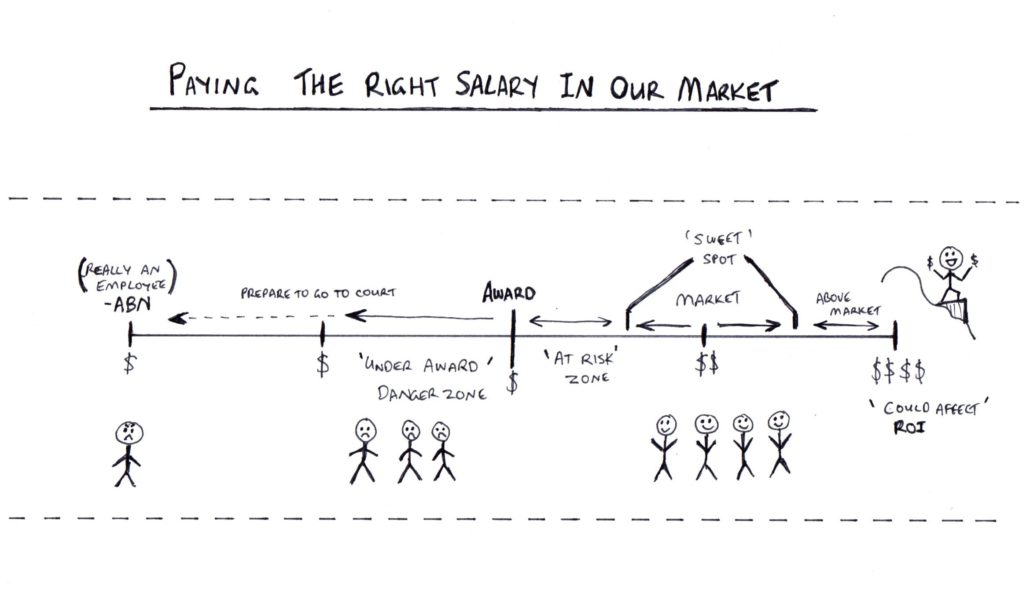
If you’re an employer that pays the Award rate or on the other hand, pays well below market rates, you could be at risk of your staff regularly keeping an eye out for a better paying role. Sometimes people just accept a job because they need one and just because you’ve filled the role, they may still be looking for the ‘better’ opportunity.

What is the right rate of pay for a role? It really is an open ended question. Some employers wish to pay the Award and that’s actually ok – it’s correct. Some wish to pay a lower salary than the market and make up for it with overtime and bonuses as a lure – this also works on occasion. Some pay well above the market rate which is attractive but can eat into the ROI and then there is the group that pay all within a certain market rate. Neither of these options are incorrect, however, what actually attracts a person to accept your role? There are quite a few answers to that question besides money, however, from our experience in the market, it sits very, very high on the list of things that applicants consider.


How do you know what salary to offer / accept?

Now you have to be reasonable here and not go off false information (there’s plenty of that out there). You need collective data. From an employer’s side, you would be silly to take a stab at what you feel is fair to pay someone for a role and hope that someone will take it. Likewise from an employee’s side you can’t just go off the information from a friend who is in a similar role to you but gets paid a whole lot more – one person is not the market. Likewise, if you have just finished Uni and the lecturer suggested that you should be worth $60k because you have a Degree now, it’s also probably (definitely) not correct.

You can look up the Award rate and pay that and you can also look at salary surveys that have been released however, realistically for our market on the Gold Coast, use them as a loose guide and not fact. You can pull a figure out of the air that you feel represents what you would pay for the role (we actually see this often) and could be correct or completely miss the mark. I had a client quite a while ago where every the answer to ‘what do you want to pay’ (for any role) was $45k – that was out by as much as $35k on the worst occasion. Some employers also look at the ABN option as it’s easier/cheaper, except when the person suddenly feels ‘wronged’ a year down the track and you end up with a FWO claim from your now identified ’employee’ not contractor.
The best options:

Yes, you have options and neither of the 3 below methods takes very long at all. They could also save you time and effort and work for you in a positive way to attract the best candidates in the market.

  • Make a call – Call a Recruiter or HR Consultant and ask what they have found when recruiting similar roles. Without spelling it out too much, Recruiters work with the market on a daily basis and can give you the salary range and benefits of recent roles they have filled – this is good information to decide on what you will pay for what particular skill level you are after.
  • Visit an online Job Board – Jump onto a job board such as SEEK type in the role you are reviewing or wishing to recruit as well as the region and look at the results. The majority of salaries are missing from the results however, every role that is posted has to have a salary range behind the scenes. From the results, use the ‘salary slider’ to work out where the majority of roles fall  – this could be a good guide to work from.
  •  Get job applicant feedback – Applicants are the market. Use the question ‘What salary range are you seeking for this role’ during your phone screening before selecting an applicant for interview and there’s your feedback. When reviewing your phone screening/shortlisting form have a look at the responses from those that you are keen on and that could be an indication of the market. Don’t discount the higher end ones either – they may ‘want’ a particular salary however we have often found that ‘want’ and ‘currently on’ are sometimes quite different.

Just doing one or all of the three points above should clear up a few questions you may have. If you do have questions regarding what to pay someone on an upcoming recruit or are conducting salary reviews soon, feel free to call our office on 1300 558 979. We are happy to help you.

The Steps I Took as a Graduate to Secure a New Job

This week we have our guest writer Jaaden who is in her final year of University studying HR. She has also joined our team and shares her story on how tough the market is and what it takes to get into your chosen field after University. Here’s her story:

Finding a job after graduation can be an overwhelming task. There is often the misconception that because we have a Degree we are more employable. However, this isn’t always the case. We often find ourselves applying for what feels like, hundreds of jobs without getting a call back. Our mornings are often greeted with a few rejection emails, and we start to question if those three to four years of late nights and frustrating group projects were worth it. Even the university listed graduate jobs seem to want that valuable “experience” everyone lists in the job description. Sounding familiar?

As a recent graduate myself, I get it. I spent just under a year seeking experience, and applying for jobs in the hope that I’d land the promised (not real) $80,000+ job in my first year out of university that everyone talks about. In reality, this isn’t always the case, so I have put together a few tactics that I used which helped me to land a job as a graduate.

Create and utilise your LinkedIn profile
LinkedIn is a tool which allows you to connect with prospective employers, search for vacant positions and create relationships with people in order to build a network. Once I decided what kind of company I would like to work for, I would follow their company page and connect with people within the organisation. Don’t be afraid to send them a message introducing yourself as a graduate, and even asking them what they look for in a candidate. This gets your name out there and could lead to a conversation about a vacant position within the organisation.

Pick up the phone
This can be quite confronting for most people, however this will build your confidence and potentially lead to a company realising that they could do with the extra hand. I suggest allocating a few hours each week, researching local businesses online and giving them a call. Introduce yourself, even prompt the question by asking if they have any opportunities available. Ask them if they have any time available to meet with you in person – this will help you in building rapport with them and strengthening your chance of being hired. Make sure to connect with them on LinkedIn afterwards, and stay in regular contact to ensure the relationship is continuously building.

Ask the question!
Don’t be afraid to ask for advice. This was the tactic which ultimately landed me the job. After building relationships and staying connected on LinkedIn, I was still an active job seeker. It was at this point that I felt I would never pursue a successful career in my chosen field, and I was beginning to look into other career paths. I decided to ask for advice, and contacted one of my connections on LinkedIn. We met again after a few months of our initial meeting and he offered me a position.

My new Manager was once somebody that I never knew, decided to call, connected with on LinkedIn and kept in regular contact with. My intentions of asking for advice were never asking for a job; however it worked out that there was a position available – it was just great timing. Whilst it didn’t just happen overnight, I stayed consistent, employed the above tactics, and was motivated and persistent, which paid off in the end. You too can have success if you have the right strategy and goal in mind to begin your new career and the chance to implement what you have learned at University – Good luck!

3 Ways To Improve Your Recruitment Outcomes

Recruiting a new staff member can be a lot of work, way more than you anticipated. Yes, it’s quite straight-forward to put an ad together, post it and wait to see what happens, however, what happens next can either pump you up or deflate you and your candidates. We often get approached by employers citing that their processing time has blown out, they’ve lost candidates and the just want to hand it over to us to start from scratch. We looked at 3 things some of our clients do that have helped improve their recruitment experience from being dull and forgettable to an enjoyable one. Even if you take just one thing from this, it is worth reading on..

1: Planning

When we say planning, we mean the entire recruitment process. Set yourself some goals and time frames to achieve during the process. By this we mean, how long do you want to advertise, what day do you want to screen applications, by what date or time frame do you want to schedule interviews, when do you want to have a job offer in place, when do you want the person to start? Instead of having the scattergun approach associated with ‘we needed them yesterday’ take a breath, map it out and stick to the schedule – you will be surprised at the difference it can make.

2: Social Media Checks

Please just do it. Let’s just say you have 300 applicants come through for an administration role which is highly likely. On average you would get down to about 20 that closely match the profile you are seeking. You can either schedule them all in for calls or bring some in for interview and hope for the best. The problem is it’s a blind date at this stage. It takes very little time to jump into Facebook or LinkedIn and look at a profile – it’s either going to be all systems go or a complete no no. You will be surprised at how many you eliminate from the list you have and save a lot of time and effort.

3: Use Technology

This is more likely targeted at a larger organisation that recruits more often. We use a cloud-based recruitment platform to load jobs across multiple platforms and track applications. The beauty of a good system is that it saves a huge amount of time, has a searchable database for upcoming roles, has functionality to be automated when communicating with job seekers, and can be accessed from multiple devices on the go or in the office. They are also not as expensive as you would think – the ROI against lost time from old school methods is huge.

With recruitment being our core function at New Point, we get results from incorporating these practices into our day to day way of doing business. You too can benefit from adding one or all of these into your recruitment process. Feel free to call us on 1300 558 979 to find out exactly how we implement these practices in our business.